Common Objections
Common Objections
Common Objections


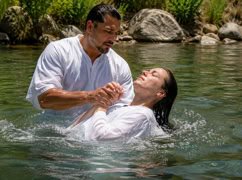
Baptism doesn’t actually wash away sins
Many evangelical Christians believe that baptism symbolizes the forgiveness of sins, but doesn’t actually accomplish it. They believe our sins are forgiven the moment we put our faith in Jesus Christ, and baptism is simply a public declaration of what has already happened.
But is that what the Bible teaches?
“Repent and be baptized … for the forgiveness of your sins”
On the day of Pentecost, after Peter preached to the crowd in Jerusalem, his listeners were deeply troubled by what they had heard. They asked Peter and the other apostles, “Brothers, what shall we do?”
Peter replied:
“Repent and be baptized, every one of you, in the name of Jesus Christ for the forgiveness of your sins. And you will receive the gift of the Holy Spirit” (Acts 2:38).
Notice what Peter didn’t say. He didn’t tell them to believe in Jesus, receive forgiveness, and then be baptized to demonstrate publicly that their sins had already been forgiven.
He told them to repent and be baptized for the forgiveness of their sins.
Some evangelicals argue that the word for means “because of.” In other words, Peter was supposedly telling them to be baptized because their sins had already been forgiven.
But that creates a problem. Peter didn’t merely tell them to be baptized for the forgiveness of their sins. He told them to repent and be baptized for the forgiveness of their sins. Was he telling them to repent because they had already been forgiven, too?
And consider how the same expression is used elsewhere in Scripture. At the Last Supper, Jesus said:
“This is my blood of the covenant, which is poured out for many for the forgiveness of sins” (Matthew 26:28).
Surely Jesus wasn’t saying that he would shed his blood because our sins had already been forgiven. He shed his blood to obtain that forgiveness.
The same expression appears in Acts 2:38. Peter was telling his listeners what they needed to do to receive forgiveness, not how to commemorate forgiveness they had already received.
“Be baptized and wash your sins away”
The account of Paul’s conversion makes the connection even more explicit.
After encountering the risen Jesus on the road to Damascus, Saul was led into the city, where he remained blind for three days. Then Ananias came to him, restored his sight, and told him what God had planned for him.
And then Ananias said:
“And now what are you waiting for? Get up, be baptized and wash your sins away, calling on his name” (Acts 22:16).
That’s remarkably straightforward.
Saul had already encountered Jesus. He had already acknowledged him as Lord. Yet Ananias still told him to be baptized and wash away his sins.
Some evangelicals argue that it was calling on the Lord’s name, rather than baptism, that washed away Saul’s sins.
But why separate the two? Ananias told Saul to be baptized and wash away his sins, calling on the Lord’s name. Baptism and faith in Christ are presented together, not as competing means of receiving forgiveness.
If baptism merely symbolizes a cleansing that has already occurred, Ananias chose a very strange way to describe it.
Does the water have some special power?
Of course not. Catholics don’t believe that water has some magical ability to remove sin.
Peter himself explained the distinction:
“And this water symbolizes baptism that now saves you also—not the removal of dirt from the body but the pledge of a clear conscience toward God. It saves you by the resurrection of Jesus Christ” (1 Peter 3:21).
Peter doesn’t say that baptism merely symbolizes salvation. He says that baptism saves us. And he explains that its saving power comes through the resurrection of Jesus Christ, not through the physical action of washing dirt from our bodies.
That’s what Catholics believe. God forgives our sins through baptism, not because there’s anything magical about the water, but because Christ established baptism as a means of giving us the grace he won through his death and resurrection.
What did the earliest Christians believe?
The Christians who lived closest to the time of the apostles understood baptism as something that actually brought about forgiveness.
Around A.D. 155, Justin Martyr described baptism as:
[The] washing that is for the remission of sins, and unto regeneration.1
And near the end of the second century, Clement of Alexandria described baptism as:
Washing, by which we cleanse away our sins; grace, by which the penalties accruing to transgressions are remitted.2
These Christians didn’t describe baptism as merely a public declaration that sins had already been forgiven. They believed God actually forgave sins through baptism.
Conclusion
The Bible doesn’t say that baptism is merely a symbol of forgiveness already received. It tells us to be baptized for the forgiveness of our sins, to be baptized and wash our sins away, and that baptism saves us through the resurrection of Jesus Christ.
None of this means that baptism earns forgiveness or that the water possesses some miraculous power of its own. Forgiveness is entirely God’s gift, made possible by the death and resurrection of Jesus Christ.
But if God has chosen baptism as the ordinary means of giving us that gift, why should we insist that it does nothing more than symbolize a gift we’ve already received?
__________
1 Justin Martyr, First Apology, 66 (c. A.D. 155). [Full text]
2 Clement of Alexandria, The Instructor, 1.6 (c. A.D. 190–200). [Full text]

Featured Articles
Copyright © 2024–[YEAR] Catholic Odyssey