The Church
The Church

The Church


Dialogue on the Reformation and the Burden of Proof
If the Reformation was unjustified, should Protestants return to the Catholic Church?
A condensed conversation with a friendly Anglican on a public message board. It began when a Presbyterian appeared to question another Presbyterian’s loyalty for considering conversion to Catholicism. My words are in black, and my Anglican friend’s are in blue.
There’s an irony, I think, in any church demanding from its members a level of loyalty and submission that its own founders weren’t willing to extend to the Catholic Church.
I don’t see why the response to that shouldn’t be, “If you didn’t have to listen to Rome, why do I have to listen to you?”
The fact that the Reformers broke communion with Rome does not mean that breaking communion with Protestant churches is trivial.
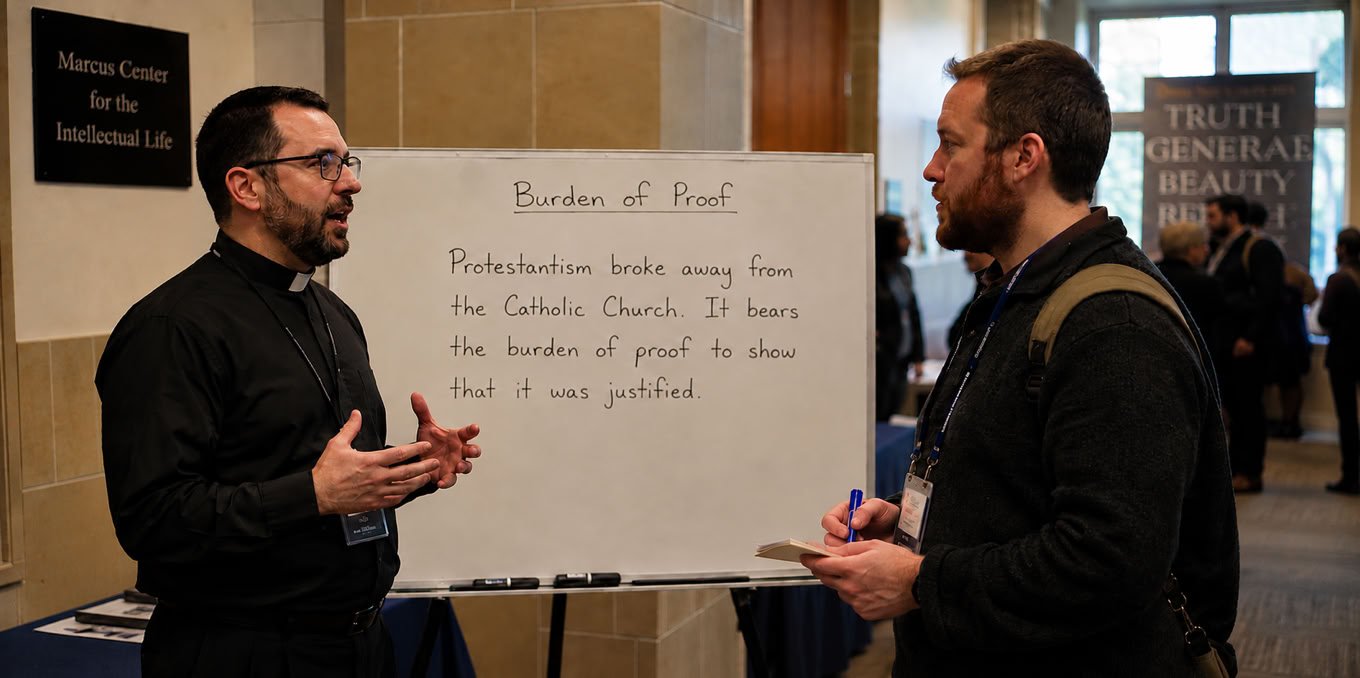
I didn’t say it was. However, I don’t think there’s a direct equivalency here. The Reformers, because they’re the ones who broke away claiming that Rome was wrong, bear the burden of proof. That means Rome gets the benefit of the doubt.
Therefore, objectively speaking, there’s a much higher level of proof that ought to be required to leave Rome than to leave Protestantism for Rome.
The Reformers believed, rightly or wrongly (I think wrongly), that Rome had erred so severely that breach of communion was necessary.
Right, and that’s what they must prove. If, in the opinion of Joe Protestant, they can’t make their case, that undermines the legitimacy of the Reformation, and Joe Protestant ought to “come home to Rome.”
Essentially, Joe Protestant must determine whether the Reformers were Josiah or Korah.
The problem is that you are putting everything in terms of who one listens to. The point is not that one should blindly listen to whoever is in authority over one, but that one should not break communion with one’s fellow Christians unless absolutely required by one’s conscience to do so.
Reformed ecclesiology does not hold that schism is only possible from one Christian body. Rather, it is a matter of breaking ties with the church to which one belongs, from which one has received the Word and the Sacraments.
I can understand that you disagree with this view. I often have doubts about it myself. But I don’t see why it’s patently ridiculous.
I didn’t say it was. But whether Protestantism is a reformation or a rebellion hinges on whether the Reformers’ contention that Rome had corrupted the Gospel was true.
If it was a true reformation, then everyone ought to be Protestant. If it was a rebellion, then no one ought to be Protestant.
I agree in this sense: A Protestant church should expect its members only to leave if they believe that the Word is no longer truly preached or the Sacraments rightly administered in essentials therein.
Hypothetical question: Was the Word truly preached and the Sacraments rightly administered by the Donatists? If so, do you think it was wrong for them to rejoin the Catholic Church?
Wait a minute. We are of course talking about individual Donatists. Obviously Donatist communities were obligated to rejoin the Catholic Church. But individuals are a more difficult matter.
On what basis do you make this distinction? I don’t understand why the same factors that obligated the Donatist communities to rejoin the Catholic Church wouldn’t also obligate the members of those communities to rejoin individually.
The obligation to Christian unity, it seems to me, is binding on all Christians.
I have a good deal of respect for Tychonius, who (as Augustine pointed out gleefully) exploded the fallacies of Donatist ecclesiology but remained Donatist, even though he was excommunicated by his own church!
I myself wouldn’t go that far. If I were excommunicated for being too Catholic (which might have happened at one time in history, given my views), I would certainly become Catholic.
Had I been a Donatist, I’m not sure what I would do. It would be a difficult choice.
I really don’t see why.
You seem to have the attitude that breakaway groups, by their very existence, acquire a legitimacy that their members are somehow obligated to preserve unless and until the group—as a group—decides to end its separation.
But Scripture repeatedly and forcefully warns against divisions. It seems to me that a group that separates from the Church bears a heavy burden of proof to show that its separation was justified.
As I’ve said several times in this debate, modern mainline Protestants are emphatically not in the position of Donatists. We may be heretics by your standards, but we are not schismatics in the Donatist sense.
The decision not to be in communion is purely on your side. I’m not saying it’s necessarily unjustified. But it is your decision, not ours.
We recognize your orders and your Eucharist. You do not recognize ours. I’m not of course saying that you are Donatists, but we are certainly not either.
Perhaps we have different definitions of schism.
As I see it, when a group rejects some aspects of the Catholic faith, leaves the Church (or is forced out), and forms a new, autonomous Christian group, whether that group’s separation is justified depends upon the rightness of its quarrel with the Catholic Church in the first place.
Its willingness to be in communion with Rome, provided it can do so on its own terms, doesn’t settle that question.
Consider the Donatists again. If they decided to rejoin the Catholic Church, were they thereby committing a schism, or ending one?
Gary, I should have thought it was clear by now that I’m talking about individual reconversion. Obviously I’m not saying that the division should not be ended. But individual conversions are unlikely to end the schism. They will just realign the boundaries a little.
I should have said helping to end a schism. Obviously, no individual believer can reasonably expect to end a schism all by himself.
But I do think that individual believers have an obligation as Christians not to remain associated with a breakaway group once they become convinced that the group’s reasons for being separate are not valid.
In other words, once one realizes that Moses is the legitimate leader of Israel, he ought not to pitch his tent with Korah any longer, even though that means breaking communion with Dathan and Abiram.
Those were the grounds on which the Reformers broke communion with Rome.
One can, of course, debate whether there are any grounds that would justify schism. The Bible seems to take Christian unity very seriously, after all.
But for the sake of argument, let’s assume that there are.
Doesn’t a Protestant owe it to himself, and to truth itself, to determine whether the Reformers have made their case that Rome had failed to truly preach the Word and rightly administer the Sacraments?
And if he concludes that they haven’t made their case, shouldn’t he also conclude that the Reformation was therefore an improper schism? And if he concludes that, shouldn’t he repudiate the Reformation and rejoin the Catholic Church?
I still think that the church one is in gets the benefit of the doubt.
Why? Given that Jesus prayed we would all be one, and given the New Testament’s repeated condemnations of divisions, it seems to me that a division should be presumed unjustified unless sufficient reasons can be offered for it.
A church that results from such a separation certainly shouldn’t be given the benefit of the doubt just because someone happens to belong to it.
And I don’t see how the passage of time changes that. If the separation was unjustified in the sixteenth century, it doesn’t become justified simply because subsequent generations have grown accustomed to it.
But the burden of proof is always on the church to which one is converting.
I think we’re talking about two different things. You’re talking about the decision facing an individual. I’m talking about the original justification for a division.
Of course someone considering conversion should have good reasons for leaving his present church. I don’t dispute that.
But surely the burden of justifying a separation rests on those who initiated it. And if that separation was unjustified, why should someone who inherits it be presumed justified in perpetuating it?
Does the passage of time somehow shift the burden of proof from those who separated to those who remained?
Here is where I disagree. It isn’t that simple.
To begin with, the errors of the Catholic Church may have been insufficient to justify schism—for that matter, the Catholic Church may even have been right on all the important points—and yet that does not mean that the Christian community to which I belong is illegitimate.
Look at the Orthodox, for instance. You admit that they are legitimate churches, although you think they are in schism.
You seem to think that if the Protestants were wrong, or at least hypersensitive, on such issues as justification and the communion of the saints, then I as a private layperson should break communion with the church to which I belong and “come home.”
Yes. No one owes allegiance to error or to an unjustified schism.
Obviously, a person who is born into such a community—or converted to it from agnosticism, or whatever—is not at fault.
But once he realizes that such a community is perpetuating a division contrary to the command of Christ himself, yes, I think it’s his duty as a Christian to do what he can to end his own participation in that division.
But that does not follow. It was the community that erred (whether on the specific doctrinal points, or simply in magnifying the importance of the disagreements), and it’s the community’s job to repent of its error.
So you think no Donatists should have rejoined the Catholic Church unless they all did? The Donatists should have reconciled en masse or not at all?
That doesn’t make any sense to me. It seems clear that if a person realizes that the community to which he belongs, through no fault of his own, ought not to have existed as a separate entity in the first place, he ought to act on that realization.
I should only leave if I think that my community’s errors are so great that I cannot in good conscience remain part of it, or, in other words, if I think that it is not a legitimate particular church.
But that’s a very different issue than whether it was justified in “separating from Rome.”
I think you set the bar way too high.
We, as Christians, have a duty to carry out the wishes of Christ that we be one and that there be no divisions among us.
The very fact that an unjustified division exists is a serious problem in itself. Why should someone continue participating in such a division once he’s convinced that it wasn’t justified in the first place?
I know it doesn’t make sense to you—again because you’re assuming a “Roman” Catholic ecclesiology.
Your assumption is that since the true Church is defined by who’s in communion with Rome, naturally Rome can dictate the terms of communion.
But try, at least imaginatively, to envision for a moment an ecclesiology that is not primarily defined by being in communion with one See.
Having been in such an ecclesiology for almost thirteen years, it’s not hard to imagine.
What concerns me is that we all be in communion with each other. Whether that is primarily defined by being in communion with Rome is another question.
And when that communion is broken, it seems to me that those responsible for the separation bear a heavy burden of proof to justify doing something that Scripture repeatedly condemns.
I don’t think that burden gets any lighter over time.
That means that if my church regards yours as fully part of the Catholic Church, and yours does not so regard mine, then it makes little sense for you to accuse me of being in schism.
Perhaps you are right in thinking that my church is not a legitimate part of the Catholic Church. But I have to be convinced that that is the case before I am obligated to “come home to Rome.”
Of course. I’ve prefaced my remarks all along with qualifiers such as “once a person becomes convinced.”
If you’re convinced that the Anglican Church’s reason for being was legitimate several hundred years ago, and that those reasons still apply today, then fine.
I’m just saying that the Anglican Church, as part of the Reformation, bears the burden of proof. And if you conclude that it can’t make its case, it isn’t schism on your part to leave it.
On the contrary, you would be repairing a schism.
I fail to see why it is laughable to say that breaking communion with those Christians is schism, just because our spiritual ancestors may have committed schism hundreds of years ago.
Again, if those organizations are themselves in schism—which is what you must decide—then you aren’t committing schism by leaving them. You’re ending your participation in that schism.
I think too often we think of the Reformation as if it were like the formation of a new church today, in which a group of like-minded people leave the church they used to go to and start another one.
But for the most part, especially at the beginning, mainstream Protestantism wasn’t like that at all.
Rather, certain preachers started preaching things that the Catholic hierarchy regarded as heretical. Eventually, with the support of secular authorities, these preachers made liturgical and disciplinary changes in their churches to make them conform to the Gospel as they understood it.
This was not about “leaving the Church.”
Not yet.
It was about reforming the Church’s doctrine and practice, without the leave of the authorities.
And yes, this often involved the fervent denunciation of those hard-headed authorities as “Antichrist.”
But it’s quite possible that the changes these preachers made were legitimate and even needed without their denunciation of the Pope and bishops being equally legitimate.
After all, you don’t stand by all the rhetoric the Catholic Church hurled at us. Why demand that we do the same?
I don’t.
Further, I understand that in many cases the Reformation began as an effort to reform the Church from within. And there were certainly things that needed reform.
But eventually, the Church declared that many of those changes, especially in doctrine, were heretical. At that point, the Reformers had to decide whether to recant and stay or stick to their guns and continue in separation.
The question remains whether that separation was justified.
Another way of putting it is that the Reformation was not based on the contention that the Catholic Church was hopelessly corrupt.
The Reformation was a set of doctrinal, liturgical, and disciplinary reforms. The question is whether those reforms were such radical departures from historic Christianity that the churches that adopted them ceased to be true churches.
But whether the Catholic Church was hopelessly corrupt isn’t the only question.
Even if the Reformers were right about some of the abuses they opposed, that doesn’t necessarily mean the resulting divisions were justified.
Yet again, we need to define schism. You insist on assuming a Catholic definition of schism. But that’s precisely what’s under discussion.
I’m referring to the existence of autonomous Christian communities that broke away from the Catholic Church, or from other communities that broke away from the Catholic Church.
I maintain that the communities that broke away bear the burden of proof and must show that their theological reasons for doing so were valid.
And if a member of such a community concludes that it hasn’t made its case, it seems to me he must also conclude that his community is perpetuating an unjustified division.
Two wrongs do not make a right.
I see. So once one finds oneself encamped with Korah, one has an obligation to remain there even if he becomes convinced that Moses is Israel’s rightful leader?
I don’t get it.
I can’t say this too often, in the hope that you will actually get the point: Protestants do not accept the Catholic assumption that the sin of “schism” is only on the side of those who separate from Rome.
Got it. I accept the teaching of the Catechism that “men of both sides were to blame” for the separation (CCC 817).
Nevertheless, regardless of whose fault it was, the fact remains that the separation exists, and that it is incumbent on the members of those separated communities to assess whether the separation was justified in the first place.
If they conclude that it wasn’t, or that it no longer is, I think they have an obligation to end at least their own participation in that separation. If they can bring others back with them, so much the better.
If in fact the divisions between Luther and Rome were not over essential questions of the Christian faith, then Rome was as wrong for excommunicating Luther as Luther was for refusing to submit.
If the divisions were not over essential questions of the Christian faith, then we have even less of an excuse for perpetuating them, don’t you think?
God have mercy on us if we are willing to ignore His command that we be one and that there be no divisions among us, and all because of issues that even we don’t think are all that important.
That being the case, why should I change from one side of the schism to the other?
Admittedly, communion with Rome is important, but that’s outweighed by the fact that I would be required to submit to all sorts of doctrines that I’m not sure are essential and that I would have to break communion with my fellow Christians.
Yes, you would, but by so doing you’d also be reestablishing communion with a great many other of your fellow Christians.
Not to speak of the fact that, as I’ve said several times now, we are quite willing to have communion with you.
Sure, provided you can do so on your own terms.
So the question is not, “Were the Reformers right in thinking Rome was Antichrist?”
The question is, “Was Rome right in declaring the Reformers heretics?”
We have made it entirely clear that we don’t think you are Antichrist, that to the contrary we think that you are our brothers in Christ, holding all the essentials of Christian faith.
Why, then, does Anglicanism continue to exist? Is it just historical inertia?
Surely you would agree with me, wouldn’t you, that the biblical warnings against divisions are strong enough to compel us to remain together, except possibly when essentials of the Christian faith are at stake?
If, as you say, those essentials are not at stake, what justification does Anglicanism have for its continued existence as a separate entity?
Christianity isn’t a matter of individual, cerebral choice. Christianity is about being called to be part of a community.
Your talk about objectivity ignores that communal aspect of the Christian faith.
But the community Christ established was supposed to be one. Surely our obligations to the communities in which we find ourselves don’t cancel our obligation to seek the unity Christ commanded.
I am in the position of belonging to a community that originally resulted from a division in which each side thought the other was heretical.
I am now certain that the Catholic Church was not and is not heretical, and I am by no means certain that my own church was or is.
But if you’re certain that the Catholic Church isn’t heretical, what justification remains for maintaining separation from it?
Anglicanism doesn’t regard itself as heretical, but it doesn’t regard the Catholic Church as heretical either.
Then we’re back to the same question. If the disagreements don’t justify separation, why should the separation continue?
But by becoming Catholic I would still be part of the division. I would just be on the other side of it from those who taught me the Christian faith and those with whom I currently worship.
But if you’ve concluded that the original division was unjustified, the two sides aren’t equivalent.
You can’t end the entire division by yourself, but you can end your own participation in it.
How is going from one side of a chasm to the other equivalent to closing the chasm?
It doesn’t close the entire chasm. But it does mean that you’re no longer personally perpetuating a separation you believe was unjustified.
We can’t be responsible for what other people do, but we are responsible for what we do.
My becoming Catholic isn’t going to help us all be in communion with one another. If it did, I’d become Catholic tomorrow. No, I wouldn’t wait until tomorrow. I’d run to the nearest priest and bang on his door.
But your becoming Catholic would help. It would be one less person out of communion with the Church.
You can’t be responsible for what other people do, but you are responsible for what you do.
I’ve tried several times to explain that the Reformation didn’t happen quite like that. Protestants were excommunicated for their opinions. If those opinions weren’t heretical, then the Catholic Church was as responsible for the schism as we were.
I accept that both sides bore responsibility for the divisions. But you’re talking about how they happened, while I’m asking whether they’re still justified.
If someone is convinced that the Catholic Church is heretical, I don’t see how he can in good conscience join it.
But if someone becomes convinced that the original separation was unjustified, I don’t see how he can in good conscience continue to participate in it.
Featured Articles
Copyright © 2024–[YEAR] Catholic Odyssey