Common Objections
Common Objections
Common Objections


The Catholic Church opposed science and condemned Galileo for proving that Earth moves
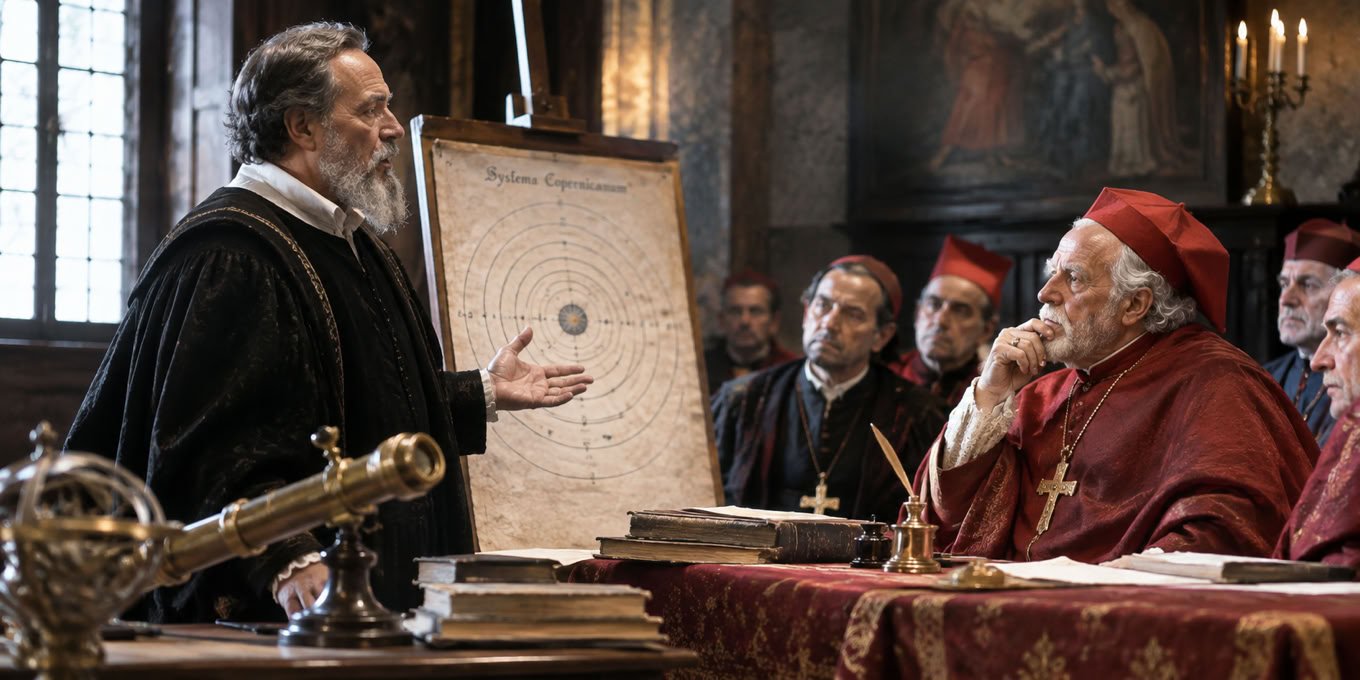
There’s some truth to this accusation. Church authorities really did condemn the idea that the Earth moves, and Galileo really was brought before the Roman Inquisition for defending it.
But Galileo hadn’t actually proved that the Earth moves. And the controversy was considerably more complicated than a simple conflict between science and religion.
What Galileo had—and hadn’t—proved
In Galileo’s day, most astronomers believed the Earth was stationary and the Sun revolved around it. Galileo championed the theory of Copernicus, who maintained that the Earth rotates on its axis and revolves around the Sun.
Galileo’s telescopic discoveries provided powerful evidence against the prevailing understanding of the solar system. But they didn’t establish that the Earth actually moved.
For example, his observations of the phases of Venus were consistent with a competing model proposed by Tycho Brahe, in which the planets orbited the Sun while the Sun orbited a stationary Earth.
And Galileo’s own attempt to demonstrate the Earth’s motion by attributing the ocean tides to it turned out to be wrong.1
There was also an important piece of evidence missing. If the Earth orbited the Sun, nearby stars should appear to shift slightly against more distant stars as the Earth moved through its orbit. Astronomers couldn’t detect that shift. It wasn’t successfully measured until 1838.2
So although Galileo was right, he couldn’t yet prove it.
What did the Church do?
In 1616, Church authorities prohibited Catholics from defending the Earth’s motion as physical reality, declaring the Copernican theory contrary to Scripture.
Seventeen years later, Galileo was tried by the Roman Inquisition, found “vehemently suspected of heresy,” and ordered to abandon his position.
He was sentenced to imprisonment, although in practice he was permitted to live under restrictions in relatively comfortable accommodations, eventually at his own villa near Florence.3
There’s no point pretending that this didn’t happen or that Church authorities were justified in suppressing a scientific theory merely because they believed it contradicted Scripture.
But it’s also important to understand that not everyone in the Church was unwilling to reconsider the prevailing interpretation of Scripture.
In 1615, Cardinal Robert Bellarmine had acknowledged that if the Earth’s motion were genuinely demonstrated, Christians would have to reconsider their interpretation of the biblical passages that seemed to contradict it. They should admit that they had misunderstood Scripture rather than deny what had been proved.4
Unfortunately, that wasn’t the approach Church authorities ultimately took.
What went wrong?
The fundamental mistake was treating a particular interpretation of Scripture as though it were itself a revealed truth.
The Bible describes the Sun rising and setting, just as we still do today. But nobody thinks we’re making a scientific claim about the Sun’s motion when we say that sunrise is at six o’clock.
The biblical authors described the world as it appeared to them. They weren’t writing astronomy textbooks.
In 1992, Pope John Paul II acknowledged that the theologians involved in Galileo’s condemnation had made precisely this mistake. They had failed to distinguish Scripture from their interpretation of Scripture and had treated a question belonging to scientific investigation as though it were a matter of revealed doctrine.5
The Church had already changed its position in 1820, when Pope Pius VII expressly permitted Catholic authors to affirm that the Earth moves.6
Does this prove that the Church opposes science?
No. It proves that Church authorities made a serious mistake in the Galileo controversy.
Galileo was right about the Earth’s motion, but he hadn’t proved it when the Church condemned his position. His opponents had legitimate scientific reasons for remaining unconvinced, but they went beyond scientific skepticism when they used ecclesiastical authority to prohibit him from defending his theory.
And that’s where they went wrong.
The Catholic Church doesn’t claim that its authorities are incapable of making mistakes about science. Nor does it claim that the Bible was written to settle questions about the physical structure of the universe. In fact, it explicitly denies that very thing.
So the Galileo affair deserves to be remembered as a serious error in the Church’s history. But it doesn’t establish that the Catholic faith is opposed to science, or that Church authorities are incapable of distinguishing scientific questions from matters of faith.
It establishes what can happen when they fail to make that distinction.
__________
1 Ron Naylor, “Galileo’s Tidal Theory,” Isis 98, no. 1 (2007): 1–22. On the phases of Venus and the Tychonic system, see the History of Science Museum, University of Oxford, “Galileo’s Most Decisive Telescopic Observation: The Phases of Venus, 1610–23.”
2 Arnab Rai Choudhuri, Astrophysics for Physicists (Cambridge University Press, 2010), 5. The first successful measurements of stellar parallax were reported in 1838.
3 Roman Inquisition, “Sentence of Condemnation of Galileo,” June 22, 1633. Museo Galileo. See also Galileo Galilei.
4 Cardinal Robert Bellarmine, letter to Paolo Antonio Foscarini, April 12, 1615. English translation.
5 Pope John Paul II, Address to the Pontifical Academy of Sciences, October 31, 1992, nos. 9–12. Full text.
6 Holy Office, decree concerning Giuseppe Settele’s Elements of Astronomy, August 16, 1820. Vatican Observatory.
Featured Articles
Copyright © 2024–[YEAR] Catholic Odyssey