Random Writings
Random Writings
Random Writings


Finding My Way Home
How I went from atheist, to Baptist, to Catholic
When I was a child, my father taught me about God and read Bible stories to my brother and me. I loved the stories, especially the beautiful illustrations, but somehow I never developed much faith in God. Maybe it was because I found church incredibly boring. Or maybe it was the influence of my mother, who was an agnostic.
My mother never tried to discourage me from believing in God, but through her I learned that not everyone believed. And as I got older, I began to think that the smartest people were usually the ones who didn’t.
By the time I reached high school, I considered myself an atheist. Technically, I suppose I was an agnostic, since I couldn’t prove that God didn’t exist. But I was pretty sure he didn’t.
I thought religion was something people had invented to explain a world they didn’t understand. Now that we had science, we didn’t need God to explain how the universe worked. The more we learned about astronomy, physics, and biology, the less room there seemed to be for him.
I looked forward to the day when humanity would finally outgrow religion altogether. I thought the world would be a better place without it.
And, if I’m being candid, I had another reason for wanting religion to disappear. I wanted to live my life on my own terms. I didn’t particularly appreciate being told that I was a sinner or that some of the things I enjoyed doing were wrong.
An unexpected question
Things began to change during the winter of 1986, when I was a student at Virginia Tech in Blacksburg, Virginia.
For years, I had thought of atheism as something liberating. Without religion telling me how to live, I could do pretty much whatever I wanted. But I was beginning to discover that doing whatever I wanted wasn’t nearly as satisfying as I’d expected.
I had a good life, at least from the outside. But something was missing. I was restless and increasingly unhappy, and I couldn’t explain why.
The more I had, the more I wanted. And the more I got, the less satisfying it seemed to be. I began to wonder whether anything would ever make me happy.
My view of the world wasn’t helping. As I understood things, human beings were simply the accidental products of natural processes. We lived for a while, and then we died. Eventually, everything we had ever done would be forgotten.
I couldn’t help wondering: What was the point?
Then one day, while sitting in a fast-food restaurant eating a bowl of chili, a thought suddenly occurred to me.
What about God?
I don’t know where that thought came from. But for the first time in years, I took the possibility seriously.
I knew that many people found meaning and purpose in their relationship with God. Of course, I didn’t want to believe in God just because the idea made me feel better. I wanted to know whether he actually existed.
And what if he did?
What if Christianity wasn’t just a collection of comforting stories? What if there really was something to it?
I decided to find out.
Discovering Christ
My roommate was a Christian who attended a small Baptist church outside Blacksburg. I asked if I could go with him the following Sunday.
That was how I found myself sitting in Gateway Baptist Church, listening to a preacher named Dewey Weaver.
Pastor Weaver was almost a caricature of everything I associated with Southern Baptist preachers. The accent, the hairstyle, the way he waved his Bible in the air—it was all there. These were the things I used to make fun of.
I felt ridiculous sitting there.
But something about his message caught my attention, because the next Sunday I went back. And the Sunday after that. Before long, I was attending regularly.
Eventually, I stopped noticing his preaching style. I even came to appreciate his sense of humor. But what kept bringing me back was the message.
Pastor Weaver preached that I was a sinner in need of a Savior. I’d heard that before, of course, but I’d never taken it seriously. Now, for the first time, I was beginning to understand what it meant.
Jesus wasn’t merely a wise teacher who told people to be nice to one another. He was God in the flesh, who loved us enough to give his life for our sins so that we could be forgiven and reconciled to God.
One night, as I was lying in bed thinking about the gospel, something clicked.
I suddenly realized that I believed it.
I couldn’t have told you exactly when I’d crossed the line from unbelief to belief. But somehow I had. The message I’d once considered ridiculous now made perfect sense to me. In fact, I wondered how I could have missed it.
That night I asked Jesus to forgive my sins and come into my heart, just as Pastor Weaver had explained. I committed myself to following him from then on, as best I could.
My life had changed.
And it happened in a Baptist church, through the preaching of a Baptist minister. I’ve never forgotten that, and I’ve never stopped being grateful for it.
Learning to be a Christian
I wanted to understand this new faith of mine, so I went to a Christian bookstore and started buying books.
Although I’d become a Christian, I still wasn’t particularly enthusiastic about organized religion. So naturally, one of the first books that caught my attention was Fritz Ridenour’s How to Be a Christian without Being Religious.
I also bought D. James Kennedy’s Why I Believe and Truths That Transform, along with Josh McDowell’s Evidence That Demands a Verdict and Paul Little’s Know Why You Believe.
Those books helped shape my understanding of Christianity. I wanted to know not only what Christians believed, but why they believed it. Having spent years as an atheist, I wasn’t interested in accepting something simply because it made me feel good. I wanted reasons.
I developed a deep respect for the Bible and a conviction that Christian beliefs ought to be grounded in Scripture.
After college, I got married and moved to the Washington, D.C., area, where I began my career. I continued studying Christianity, reading the Bible, and even learning a little Greek.
But there was one problem I couldn’t seem to solve.
I couldn’t find a church where I felt entirely at home.
My wife and I visited twelve different churches in Northern Virginia. There were Baptist churches, Presbyterian churches, Assemblies of God churches, a Messianic Jewish congregation, a charismatic Episcopal church, and several nondenominational churches.
We found good people and good things in all of them. But sooner or later, we’d encounter some teaching or practice that didn’t seem quite right, and we’d move on.
Eventually, we settled into a small Bible church. It wasn’t a perfect fit, but we liked it, and frankly, we were tired of church shopping.
Throughout those years, there was one church I never seriously considered.
The Catholic Church.
The church I thought I understood
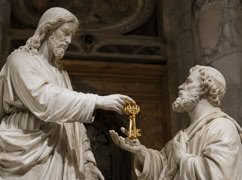
I didn’t think the pope was the Antichrist, and I wouldn’t have said that Catholics weren’t Christians. But my vague impression of the Catholic Church was that it had accumulated a great many teachings that weren’t biblical, and that it had a strange fixation on Mary the mother of Jesus.
I assumed that most Catholics were Catholic simply because they’d been raised that way. If they ever sat down and seriously studied the Bible, I figured they’d probably become Protestants.
To be fair, some of the Catholics I knew reinforced that impression. They didn’t seem particularly interested in Scripture or in developing a relationship with Christ. One Catholic friend told me that his goal every Sunday was to get into Mass, “put in his hour,” and get out.
I knew plenty of Protestants who took their faith seriously. I didn’t know many Catholics who did.
Looking back, I can see how unfairly I generalized from those experiences. But at the time, I thought Catholicism was what happened when people added a lot of man-made teachings to Christianity and gradually lost sight of the gospel.
Then something happened that challenged everything I thought I knew.
One day, a Christian friend at work came into my office carrying a book. A Catholic acquaintance had given it to him, and he wanted my help responding to its arguments.
The book was Catholicism and Fundamentalism, by Karl Keating.
I was amused by the idea that someone had written an entire book defending Catholicism from the Bible. I figured it wouldn’t be difficult to find the flaws in his arguments.
So I began reading, looking for things I could refute.
But something unexpected happened.
Keating was intelligent, articulate, and clearly knew his Bible. More importantly, the things he wrote made sense.
At first, I read the book almost like a prosecuting attorney, searching for weaknesses. But gradually I found myself trying to understand his arguments instead of simply trying to defeat them.
And the more I understood, the more uncomfortable I became.
I discovered that the Catholic Church didn’t actually teach some of the things I’d always assumed it taught. And some of the teachings I’d dismissed as unbiblical turned out to have substantial biblical support.
I began to realize that much of what I thought I knew about Catholicism had come from people who opposed it. I’d never really taken the time to hear Catholics explain their own beliefs.
That was an embarrassing discovery.
I wasn’t convinced that Catholicism was right. Not by a long shot. But I was beginning to realize that I couldn’t dismiss it nearly as easily as I’d expected.
And that bothered me. I wanted to know what I believed and why I believed it. If my understanding of Christianity was correct, I wanted to be able to defend it.
So I started investigating.
Following the evidence
I began reading everything I could find on both sides of the Catholic-Protestant divide.
On the Catholic side, I read authors such as James Akin, Dave Armstrong, Scott Hahn, and Mark Shea. On the Protestant side, I read Norman Geisler, D. James Kennedy, Fritz Ridenour, John Stott, and others.
I wasn’t looking for reasons to become Catholic. Quite the opposite. I wanted to find a convincing Protestant response to the Catholic arguments.
But I kept running into the same problem.
Too often, the Protestant authors seemed to be arguing against things the Catholic Church didn’t actually teach. And when I compared their arguments with the Catholic explanations, I increasingly found the Catholic position more persuasive.
I began questioning two beliefs that had been foundational to my evangelical understanding of Christianity: sola Scriptura, the idea that Scripture is the Christian’s only rule of faith, and sola fide, the doctrine of justification by faith alone.
I’d always assumed these teachings were plainly stated in the Bible. But now I was having trouble finding them there, at least in the sense I’d understood them.
Even more troubling, I was beginning to notice passages that seemed to support the Catholic understanding of Christianity more naturally than my own.
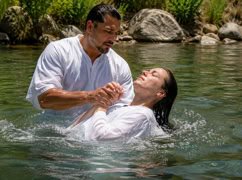
For example, Jesus told Nicodemus that we must be born of water and the Spirit. I’d learned to interpret the water as something other than baptism. But why? The Catholic understanding—that Jesus was speaking about baptism—seemed straightforward.
Jesus told his apostles, “If you forgive the sins of any, they are forgiven them.” I’d understood this as a reference to preaching the gospel. But the Catholic explanation, that Jesus was actually giving his apostles authority to forgive sins in his name, seemed to take his words more directly.
And when Jesus said, “This is my body,” I’d always understood him to be speaking symbolically. Catholics believed he meant what he said.
Of course, I knew that biblical interpretation isn’t always as simple as taking every statement literally. Jesus used metaphors and figures of speech, and Catholics recognize that too.
But I was beginning to wonder whether I’d sometimes been interpreting passages figuratively, not because the context required it, but because a more straightforward reading didn’t fit my theology.
That was a disturbing possibility.
I’d always taken pride in being a Bible-believing Christian. I still did. But I was beginning to wonder whether my understanding of the Bible was being shaped more by the theology I’d inherited than I’d realized.
I hadn’t stopped believing Scripture, but I was beginning to question whether I’d understood it correctly.
Meeting the early Christians
Another discovery proved just as important.
As an evangelical, I’d spent years studying the Bible. But I knew remarkably little about the Christians who lived immediately after the apostles.
I’d never even heard of Ignatius of Antioch or Polycarp. I knew nothing about Clement of Rome, Justin Martyr, or Irenaeus.
Yet these men lived in the first generations of Christianity. Some had known the apostles personally, and others had learned from those who did.
That struck me as extraordinary.
Here were Christians who lived much closer to the time of the apostles than I did, who spoke their language and understood their culture. Some had learned the faith directly from people who had known Jesus.
Wouldn’t it make sense to find out what they believed?
So I started reading their writings.
And once again, I was surprised.
These early Christians described a Church with bishops, priests, and deacons. They spoke of baptism as something through which God actually gives new life. They believed that the Eucharist was truly the body and blood of Christ. And they placed great importance on preserving the teaching handed down from the apostles through the leaders of the Church.
Ignatius of Antioch, writing early in the second century, even referred to the “Catholic Church.”
This wasn’t the picture of early Christianity I’d expected to find.
I’d assumed that the first Christians believed pretty much what I believed, and that Catholic doctrines had been added centuries later.
But the more I read, the harder it became to maintain that assumption.
I wasn’t finding a second-century version of my evangelical Bible church. I was finding something that looked remarkably Catholic.
That didn’t settle every question, of course. But it raised a very important one.
If the Catholic Church had departed from the faith of the apostles, when had that happened? And where was the evidence of the earlier, supposedly more Protestant Christianity that it had replaced?
I couldn’t find it.
I began to understand what John Henry Newman meant when he wrote, “To be deep in history is to cease to be a Protestant.”
A difficult decision
None of this was easy for me.
I loved being an evangelical Christian. My faith in Christ had begun in a Baptist church, and I’d spent years learning from evangelical pastors, teachers, and authors. These were the people who had taught me to love Scripture and to take Christianity seriously.
I wasn’t looking for a different religion. I wasn’t unhappy with Jesus, and I certainly wasn’t trying to escape the demands of Christianity.
I was trying to follow the truth wherever it led.
And increasingly, it seemed to be leading me toward the Catholic Church.
At some point, I had to ask myself a question I’d never seriously considered before.
What if I was wrong?
Not wrong about Jesus. Not wrong about the gospel I’d come to believe as a college student. But wrong about some of the assumptions I’d made concerning the Church, the sacraments, and how Christian doctrine was supposed to be understood.
I had to admit that being a Bible-believing Christian didn’t guarantee that my interpretation of the Bible was correct.
And if the Catholic Church really was the Church Christ established, then remaining outside it simply because I’d always thought Catholicism was wrong didn’t make much sense.
Eventually, I became convinced that the Catholic understanding of Christianity made better sense of both Scripture and the historical evidence.
So I became Catholic.
It wasn’t a rejection of the faith I’d found at Gateway Baptist Church. It was, in my understanding, a continuation of the journey that had begun there.
I still believed that Jesus Christ was God in the flesh, that he died for my sins, that he rose from the dead, and that salvation was possible only through his grace.
I still loved the Bible. In fact, my respect for Scripture was one of the principal reasons I’d become Catholic.
What had changed was my understanding of the Church Jesus established and how he intended his followers to receive and live out the faith.
I hadn’t abandoned Christianity as I’d known it. I’d come to believe that I’d found its fullness.
Looking back
It’s been many years since I first walked into that Baptist church in Blacksburg, and more than twenty-five years since I became Catholic.
A lot has happened in the meantime. I’ve moved, lost my first wife, and remarried. Life has brought changes I couldn’t have imagined when I first wrote this story.
But one thing hasn’t changed: I’m profoundly grateful for the evangelical Christians who introduced me to Jesus Christ.
I don’t look back on those years as wasted time or as a period when I wasn’t really a Christian. Quite the opposite. They were the formative years of my Christian life, and much of what I learned then remains with me today.
I also know that many of the misconceptions I once held about Catholicism are still widespread among evangelical Christians. I understand them because I held them myself.
That’s one of the reasons I created Catholic Odyssey.
I’m not interested in convincing evangelicals that their faith in Christ is somehow worthless or that everything they’ve learned is wrong. I know better than that.
What I hope to do is help them understand what Catholics actually believe, why we believe it, and how those beliefs fit with Scripture and the Christianity of the earliest centuries.
They may not agree with my conclusions. That’s fine. But at least we can begin by understanding one another.
And in a world where Christians increasingly face challenges that transcend our denominational differences, that understanding matters more than ever.
After all, we have far more in common than many of us realize.
I know. I’ve been on both sides.

Featured Articles
Copyright © 2024–[YEAR] Catholic Odyssey