Common Objections
Common Objections
Common Objections


Catholics aren’t really Christians
Some Protestants believe that Catholics aren’t really Christians. They may acknowledge that Catholics believe in Jesus Christ, read the Bible, and attend church, but they maintain that Catholicism teaches a false gospel. Consequently, they regard Catholicism not as another form of Christianity, but as a different religion altogether.
For example, the influential evangelical pastor John MacArthur, in an article titled Is Roman Catholicism Biblical?, argued that Catholicism’s rejection of sola Scriptura and its understanding of justification place it outside authentic Christianity. He concluded:
It is a false and deceptive form of Christianity.1
The evangelical apologetics website GotQuestions.org expresses a similar view in an article titled I Am a Catholic. Why Should I Consider Becoming a Christian?
The article identifies two principal objections to Catholicism: its understanding of biblical authority and its teaching about salvation. According to the authors, Catholics give Church tradition an authority that belongs to Scripture alone, and they teach a form of salvation that depends on religious works and sacraments rather than faith in Christ alone.2
Notice how these critics define authentic Christianity. They regard certain Protestant doctrines, particularly sola Scriptura and justification by faith alone, as essential to the Christian faith. Since Catholicism rejects those doctrines, they conclude that it isn’t authentically Christian. But that assumes the very thing that needs to be demonstrated: that accepting those doctrines is necessary to being a Christian in the first place.
So, what makes someone a Christian?
What is a Christian?
The word Christian first appears in the Bible in Acts 11:26, where Luke tells us that “the disciples were first called Christians in Antioch.”
The word means a follower of Christ. But Christianity is more than simply professing admiration for Jesus. From its earliest centuries, the Church has identified certain beliefs as fundamental to the Christian faith, including the Trinity, the Incarnation, the divinity of Christ, his death for our sins, and his bodily resurrection.
The Catholic Church professes every one of these doctrines.
Catholics believe that Jesus Christ is the eternal Son of God, the second Person of the Holy Trinity, who became man for our salvation. He was conceived by the Holy Spirit, born of the Virgin Mary, suffered and died on the cross for our sins, rose bodily from the dead on the third day, ascended into heaven, and will return to judge the living and the dead. They believe that he is the only Savior of the world and that no one can be saved apart from him.
In fact, Catholics profess these beliefs every Sunday at Mass when they recite the Nicene Creed, a profession of Christian faith that has been recognized by Christians for more than sixteen centuries.
Interestingly, GotQuestions.org, the same evangelical website that asks Catholics why they should consider becoming Christians, defines a true Christian as someone who has been born again by God, saved by grace through faith, and placed their trust in Jesus Christ and his saving death and resurrection. It also identifies love for others and obedience to God’s Word as marks of a genuine Christian. Catholics affirm all these things.
Yet in explaining what makes someone a Christian, GotQuestions never identifies acceptance of sola Scriptura or the Protestant understanding of justification as a requirement.3
But what about the objections raised by MacArthur and others?
But Catholics believe in a false gospel!
The most serious objection concerns salvation. MacArthur and other evangelical critics argue that Catholicism teaches salvation through faith plus works, whereas the Bible teaches justification by faith alone.
But what does the Catholic Church actually teach?
The Catechism of the Catholic Church states:
Our justification comes from the grace of God. Grace is favor, the free and undeserved help that God gives us to respond to his call to become children of God, adoptive sons, partakers of the divine nature and of eternal life. (CCC 1996)
And again:
Since the initiative belongs to God in the order of grace, no one can merit the initial grace of forgiveness and justification, at the beginning of conversion. (CCC 2010)
Nor is this some modern attempt to make Catholicism sound more Protestant. The Council of Trent explicitly rejected the idea that human beings can be justified by their own works without God’s grace through Jesus Christ.4
Catholics and evangelicals disagree about justification. But the disagreement isn’t over whether Jesus Christ saves us. It’s over how he saves us and what his saving grace accomplishes in us.
But Catholics reject the authority of Scripture!
Another objection concerns the relationship between Scripture and Church authority.
Many evangelical Protestants believe that the Bible is the Christian’s only rule of faith and practice. Because Catholics also recognize the teaching authority of the Church, critics sometimes conclude that Catholics have rejected the authority of Scripture.
But rejecting sola Scriptura is not the same thing as rejecting Scripture.
The Catholic Church teaches that the Bible is the inspired Word of God and that everything asserted by its inspired authors is asserted by the Holy Spirit. It regards Scripture as authoritative and without error in what God intended to communicate through it.
The disagreement isn’t over whether Scripture is authoritative. It’s over whether Scripture is the Church’s only authority.
Catholics believe that Christ entrusted his teachings to the apostles, who transmitted them both orally and in writing, and that the Church has a responsibility to preserve and faithfully interpret that apostolic teaching.
What about all those unbiblical Catholic doctrines?
Some critics point to Catholic beliefs about Mary, the saints, purgatory, the papacy, or the Eucharist as further evidence that Catholicism is not authentic Christianity.
But this raises the same fundamental question: Does a Christian have to hold the correct position on every disputed doctrine in order to be a Christian?
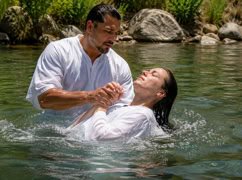
Consider baptism. Some Christians believe that baptism actually brings about the forgiveness of sins and spiritual regeneration. Others believe it is merely an outward symbol of a salvation already received.
Both cannot be entirely correct. But does that mean one group isn’t Christian?
A Protestant may believe that praying for the intercession of the saints is wrong, that the papacy is unbiblical, or that Catholic teaching about purgatory is mistaken. But even if the Protestant critic were correct about every one of them, it would not follow that Catholics do not believe in Jesus Christ and shouldn’t be called Christians.
A Christian can be mistaken about a Christian doctrine without ceasing to be a Christian.
Otherwise, Christianity would consist exclusively of those who have managed to get every theological question right, and that might reduce the Church to twelve again.
Were there no Christians before the Reformation?
There’s another difficulty with the claim that Catholicism is not Christianity.
The Catholic Church did not suddenly appear in the sixteenth century as a rival to Christianity. Its history extends back through the medieval Church to the early centuries of Christianity, long before the Protestant Reformation.
Throughout those centuries, Christians worshiped Jesus Christ, proclaimed his death and resurrection, baptized converts, celebrated the Eucharist, studied the Scriptures, and spread the gospel throughout the world.
Many beliefs that Protestants today regard as distinctively Catholic were held by Christians long before the Reformation, including baptismal regeneration, the real presence of Christ in the Eucharist, the authority of bishops, and the importance of apostolic succession.
In fact, we find evidence of some of these beliefs in Christian writings from the first and second centuries, when the apostles themselves were still within living memory.
If holding such beliefs means that someone is not a Christian, what are we to make of the Christians who held them during the first fifteen centuries of Christian history?
Were the countless men and women who worshiped Christ, suffered persecution, evangelized nations, and devoted their lives to following him not Christians?
If your definition of a Christian excludes Catholics, then your definition is so narrow that it excludes most of the Christians who have ever lived. That should give us reason to question the definition, rather than the Christianity of those it excludes.
Even prominent Protestants recognize Catholics as Christians
Not all Protestants accept the argument that Catholicism is a false form of Christianity. In fact, some of the most influential evangelical Protestants have explicitly rejected the idea that Catholics cannot be genuine Christians.
Billy Graham, the renowned Baptist evangelist, said:
“I have found many people in the Roman Catholic Church, both clergy and laity, who I believe are born-again Christians.”5
The influential evangelical theologian John Stott likewise acknowledged Catholics as Christians. Referring to Catholics and others outside evangelical Protestantism, he wrote:
Insofar as they profess Jesus Christ as God, Lord and Saviour, we certainly do not deny them the Christian name.6
J. I. Packer, another prominent evangelical theologian, asked in a 1994 article:
Do we recognize that good evangelical Protestants and good Roman Catholics … are Christians together?
And answered:
We ought to recognize this, for it is true.7
Packer went on to criticize Protestants who denied that Catholics could be Christians without leaving the Catholic Church.
Conclusion
Christianity didn’t begin with the Protestant Reformation. Catholics profess the historic Christian faith, worship Jesus Christ as God, and acknowledge him as the only Savior of the world.
You may believe we’re wrong about some important things. But that doesn’t mean we’re not Christians.
__________
1 John MacArthur, “Is Roman Catholicism Biblical?” Grace to You. https://www.gty.org/library/Print/Articles/A190
2 GotQuestions.org, “I Am a Catholic. Why Should I Consider Becoming a Christian?” https://www.gotquestions.org/Catholic-Christian.html
3 GotQuestions.org, “What Is a Christian?” https://www.gotquestions.org/what-is-a-Christian.html
4 Council of Trent, Session VI (January 13, 1547), Decree on Justification, canon 1. The canon condemns the proposition that human beings can be justified before God by their own works, without divine grace through Jesus Christ.
5 Billy Graham, “Interview with Billy Graham: Preachers, Politics and Temptation,” Time (1990). https://time.com/archive/6714982/interview-with-billy-graham-preachers-politics-and-temptation/
6 John Stott, “What Is the Evangelical Faith?” Reprinted in The Reformation: Best of Lausanne. https://lausanne.org/wp-content/uploads/2017/10/Reformation-Best-of-Lausanne.pdf
7 J. I. Packer, “Why I Signed ‘Evangelicals and Catholics Together,’” Christianity Today, December 12, 1994. https://www.christianitytoday.com/1994/12/j-i-packer-why-i-signed-evangelical-and-catholics-together/
Featured Articles
Copyright © 2024–[YEAR] Catholic Odyssey