Common Objections
Common Objections
Common Objections


The Bible doesn’t teach that Jesus founded a single, visible Church
Many evangelical Protestants believe that the Church Jesus founded isn’t any particular religious organization. It’s the invisible fellowship of everyone who has genuinely accepted Jesus Christ as Savior, regardless of which denomination they belong to.
Catholics agree that the Church has a spiritual dimension. But is that all it is? Or did Jesus establish a visible Church, with identifiable leaders, the authority to govern its members, and a unity that would continue from one generation to the next?
A Church you could actually see
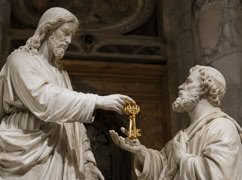
When Jesus said he would establish his Church, he told Simon, “You are Peter, and on this rock I will build my church” (Matthew 16:18). He also promised him the keys of the kingdom of heaven and the authority to bind and loose (Matthew 16:19). The other apostles were subsequently given similar authority (Matthew 18:18).
As Protestant New Testament scholar Craig S. Keener explains, binding and loosing “were technical terms for the pronouncement of rabbis on what was and was not permitted (to bind was to forbid, to loose to permit).” He concludes that Matthew 16:19 “probably refers primarily to a legislative authority in the church.”1
I’ve discussed Peter’s particular role more fully in my article, "I Tell You That You Are Peter".
But consider what Jesus said in Matthew 18:15–17:
“If your brother sins against you, go and show him his fault, just between the two of you. If he listens to you, you have won your brother over. But if he will not listen, take one or two others along, so that ‘every matter may be established by the testimony of two or three witnesses.’ If he refuses to listen to them, tell it to the church; and if he refuses to listen even to the church, treat him as you would a pagan or a tax collector” (emphasis added).
How could anyone bring a dispute before an invisible Church?
Jesus was describing a recognizable community capable of hearing a case, rendering a judgment, and expecting its members to accept that judgment. Refusal to listen to the Church could even result in exclusion from the community.
Likewise, Hebrews 13:17 instructs Christians to “Obey your leaders and submit to their authority. They keep watch over you as men who must give an account.”
Clearly, the Church Jesus established wasn’t merely an invisible fellowship of believers. It had visible leaders who exercised genuine authority.
But that establishes only part of the Catholic claim. After all, evangelical congregations have visible leaders, too.
The larger question is whether Jesus intended his followers to belong to one continuing Church, united in faith and leadership, or whether independent congregations could each determine for themselves what Christianity teaches.
The Council of Jerusalem
An especially instructive example is found in Acts 15.
Some Christians were teaching that Gentile converts had to be circumcised and observe the Mosaic Law in order to be saved. Paul and Barnabas strongly disagreed.
This was no minor dispute. It concerned the very conditions of salvation.
How did the Church resolve it?
Rather than leaving each congregation to decide the question for itself, the Christians in Antioch sent Paul and Barnabas to Jerusalem to consult the apostles and elders (Acts 15:2).
The apostles and elders gathered to consider the matter. They heard testimony, discussed the question, and examined the Old Testament Scriptures. Peter spoke, Paul and Barnabas described what God had accomplished among the Gentiles, and James appealed to the prophets.
Then they reached a decision. Gentile converts were not required to be circumcised or observe the Mosaic Law as a condition of salvation.
The apostles and elders issued a letter communicating their judgment:
It seemed good to the Holy Spirit and to us not to burden you with anything beyond the following requirements (Acts 15:28).
Notice the significance of those words. The council didn’t merely offer an interpretation that individual Christians were free to accept or reject. Its members understood themselves to be acting under the guidance of the Holy Spirit, and they issued a decision for the Church.
And how were Christians expected to respond?
As Paul and his companions traveled from town to town, “they delivered the decisions reached by the apostles and elders in Jerusalem for the people to obey” (Acts 16:4, emphasis added).
That’s hardly the picture of independent congregations, each free to determine Christian doctrine for itself.
The Church had a means of settling doctrinal disputes, and its decisions were intended to be accepted beyond the congregation in which they originated.
Was that authority supposed to continue?
But what happened when the apostles died? Was this visible, authoritative leadership structure intended to disappear with them?
The New Testament gives us good reason to think otherwise.
When Judas abandoned his apostolic ministry, Peter explained that another man must take his place, quoting the Psalms: “His office let another take” (Acts 1:20). Matthias was subsequently chosen to take Judas’s place among the Twelve (Acts 1:15–26).
More importantly, the apostles established continuing leadership in the churches they founded.
Acts 14:23 tells us that Paul and Barnabas appointed elders in each church. Paul instructed Titus to appoint elders in every town (Titus 1:5). And when he addressed the elders of Ephesus, he reminded them that the Holy Spirit had made them overseers, entrusted with shepherding the Church of God (Acts 20:28).
These weren’t merely informal gatherings of believers. They were organized Christian communities with appointed leaders responsible for their spiritual welfare.
Even more significant is Paul’s instruction to Timothy:
And the things you have heard me say in the presence of many witnesses entrust to reliable people who will also be qualified to teach others (2 Timothy 2:2).
Notice the succession implied here. Paul had taught Timothy. Timothy was to entrust that teaching to reliable people, who would themselves be qualified to teach others.
That's four generations of Christian teachers, beginning with Paul himself.
The apostles didn't merely appoint leaders to govern the churches. They also made provision for their teaching to be preserved and passed on from one generation to the next.
But did the Christians who came after the apostles understand the Church this way?
The testimony of the early Church
Writing near the end of the first century, Clement of Rome explained that the apostles had anticipated the need for continuing leadership:
And our Apostles knew through our Lord Jesus Christ that there would be strife over the name of the bishop’s office. For this cause therefore, having received complete foreknowledge, they appointed the aforesaid persons, and afterwards they provided a continuance, that if these should fall asleep, other approved men should succeed to their ministration.2
Clement was writing while the apostolic generation was only just passing away. Yet he describes succession to Church office not as an innovation, but as something the apostles themselves had provided for.
A few years later, Ignatius of Antioch described the Church’s visible organization in unmistakable terms:
It is necessary, therefore—and such is your practice—that you do nothing without the bishop, and that you be subject also to the presbytery, as to the Apostles of Jesus Christ our hope, in whom we shall be found, if we live in Him.3
And in the very next chapter, Ignatius wrote:
In like manner let everyone respect the deacons as they would respect Jesus Christ, and just as they respect the bishop as a type of the Father, and the presbyters as the council of God and college of Apostles. Without these, it cannot be called a Church.4
Without these, it cannot be called a Church
Ignatius evidently didn’t think a congregation could simply organize itself however it pleased and still claim to be the Church Christ established.
But the early Christians were concerned with more than preserving an organizational structure. They were also concerned with preserving the faith the apostles had taught.
When the Gnostics claimed to possess secret doctrines supposedly handed down from the apostles, the Church Fathers pointed instead to the public teaching preserved in churches whose leaders could trace their succession to the apostles.
Irenaeus of Lyons explained:
It is not necessary to seek the truth among others which it is easy to obtain from the Church; since the apostles, like a rich man [depositing his money] in a bank, lodged in her hands most copiously all things pertaining to the truth: so that every man, whosoever will, can draw from her the water of life. For she is the entrance to life; all others are thieves and robbers. …
True knowledge is [that which consists in] the doctrine of the apostles, and the ancient constitution of the Church throughout all the world, and the distinctive manifestation of the body of Christ according to the successions of the bishops, by which they have handed down that Church which exists in every place.5
For Irenaeus, apostolic succession and apostolic teaching belonged together. The legitimate successors of the apostles were responsible for preserving the faith the apostles had publicly taught.
This is a very different understanding of the Church from the idea that anyone can establish an independent congregation, announce that he’s teaching the true Gospel, and thereby claim the same standing as churches whose leaders could trace their succession to the apostles.
And what did these early Christians call this visible, organized Church?
Ignatius of Antioch called it the Catholic Church. Writing to the Christians at Smyrna, he said:
Wherever the bishop appears, let the people be there; just as wherever Jesus Christ is, there is the Catholic Church.6
The word catholic comes from Greek and means universal. Ignatius used it to describe a Church whose visible organization included bishops, presbyters, and deacons.
Early Church historian J. N. D. Kelly, a Protestant, describes how the term came to be understood:
As regards [the name] “Catholic” … in the latter half of the second century at latest, we find it conveying the suggestion that the Catholic is the true Church as distinct from heretical congregations (cf., e.g., Muratorian Canon). … What these early fathers were envisaging was almost always the empirical, visible society; they had little or no inkling of the distinction which was later to become important between a visible and an invisible Church.7
That’s a remarkable observation from a Protestant historian. The earliest Christians didn't generally think of the Church as an invisible fellowship that could be separated from the visible Christian community.
For them, the Church was a recognizable society with an identifiable faith, worship, and leadership.
That they may all be one
There’s another important reason to believe Jesus intended his followers to belong to one continuing Church: unity.
Throughout the New Testament, Christians are repeatedly instructed to preserve their unity.
Paul wrote:
I appeal to you, brothers, in the name of our Lord Jesus Christ, that all of you agree with one another so that there may be no divisions among you and that you may be perfectly united in mind and thought (1 Corinthians 1:10).
He also warned believers to avoid those who caused divisions contrary to the teaching they had received (Romans 16:17).
Unity wasn’t merely an optional ideal. Christians were expected to preserve it, and divisions within the Church were treated as a serious matter.
But why was unity so important?
Jesus himself gives us the answer in his prayer to the Father:
I have given them the glory that you gave me, that they may be one as we are one: I in them and you in me. May they be brought to complete unity to let the world know that you sent me and have loved them even as you have loved me (John 17:22–23).
Notice the purpose of this unity: that the world may know that the Father sent Jesus.
Christians belonging to different denominations can sincerely love one another, cooperate in charitable works, and recognize one another as fellow believers. That unity is real and valuable.
But Christians can cooperate in charitable works while disagreeing about what Christ and his apostles taught. Is that the kind of unity Jesus had in mind when he prayed that his followers would be one as he and the Father are one?
And if the unity Jesus prayed for was supposed to convince the world that the Father sent him, shouldn't it be a unity the world could actually see?
The New Testament’s insistence on unity makes much more sense if Jesus intended his followers to belong to one Church, with a common faith and a means of resolving disagreements, rather than a collection of independent congregations that might disagree about essential Christian doctrines.
Conclusion
Of course, demonstrating that the early Church was visible, organized, and governed by successors to the apostles doesn’t by itself settle every question about the Catholic Church today. But it establishes something important: the kind of Church Catholics claim Christ founded is the kind of Church we actually find in the New Testament and the earliest Christian writings.
Jesus appointed apostles and gave them authority. The apostles exercised that authority in governing the Church and settling doctrinal disputes. They established local leaders and entrusted others with preserving and teaching what they had received. And the earliest Christian writers describe a visible Church governed by successors to the apostles, united in faith and leadership.
The Church Jesus founded was never intended to be merely an invisible association of believers, with no continuing, authoritative leadership. It was, and remains, a visible society, “built upon the foundation of the apostles and prophets, Jesus Christ himself being the chief corner stone” (Ephesians 2:20).
And it is “the church of the living God, the pillar and ground of the truth” (1 Timothy 3:15).
__________
1 Craig S. Keener, The IVP Bible Background Commentary: New Testament (Downers Grove, IL: InterVarsity Press, 1993), 90.
2 Clement of Rome, First Letter to the Corinthians 44:1–2 (c. A.D. 96), translated by J. B. Lightfoot, in The Apostolic Fathers, edited by J. R. Harmer (London: Macmillan and Co., 1891). https://ccel.org/ccel/lightfoot/fathers/fathers.ii.i.html.
3 Ignatius of Antioch, Letter to the Trallians 2:1–3 (c. A.D. 110), in The Faith of the Early Fathers, vol. 1, edited and translated by William A. Jurgens (Collegeville, MN: Liturgical Press, 1970), 20.
4 Ibid., 3:1–2, 20–21. Emphasis added.
5 Irenaeus of Lyons, Against Heresies 3.4.1 and 4.33.8, translated by Alexander Roberts and William Rambaut, in Ante-Nicene Fathers, vol. 1, edited by Alexander Roberts, James Donaldson, and A. Cleveland Coxe (Buffalo, NY: Christian Literature Publishing Co., 1885).
6 Ignatius of Antioch, Letter to the Smyrnaeans 8:2, c. A.D. 110.
7 J. N. D. Kelly, Early Christian Doctrines (New York: Harper & Row, 1960), 190.
Featured Articles
Copyright © 2024–[YEAR] Catholic Odyssey