Common Objections
Common Objections
Common Objections


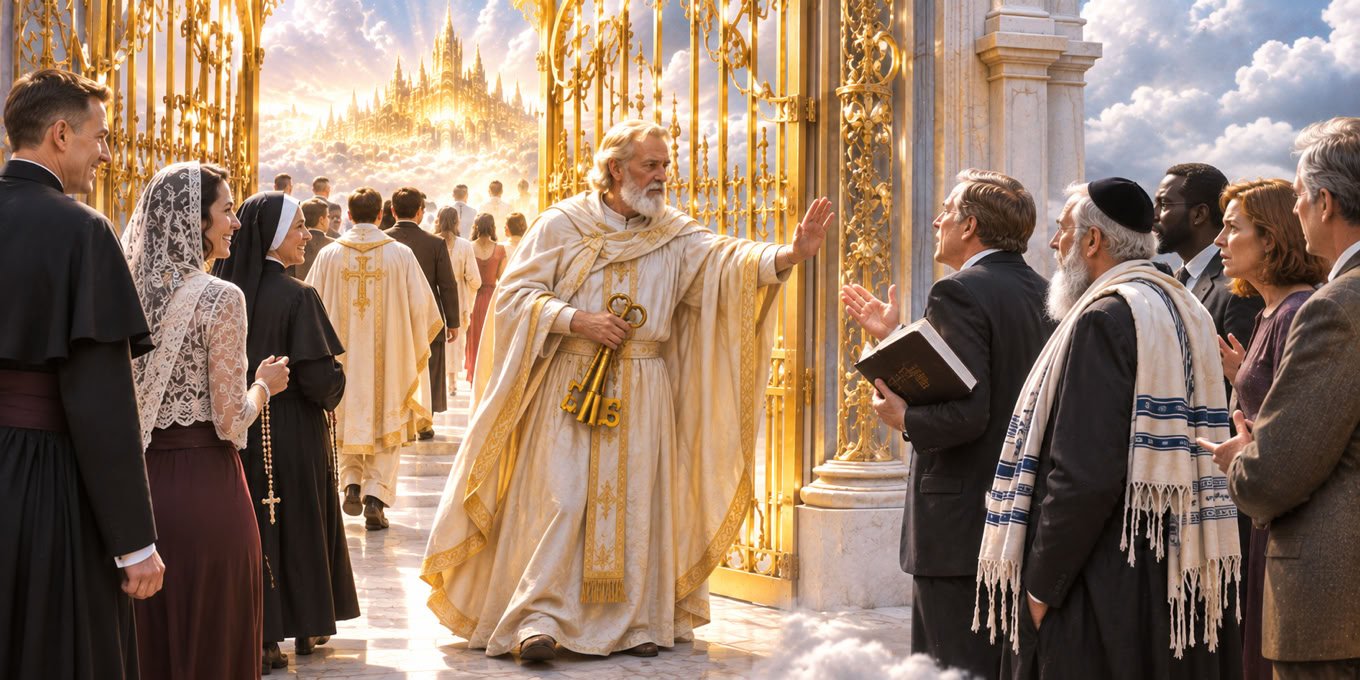
The Catholic Church teaches that all non-Catholics are going to hell
No, actually, the Catholic Church teaches that anyone, anywhere in the world, can be saved through the grace of God—even someone who has never heard of Jesus Christ or the Catholic Church.
The Catechism of the Catholic Church explains:
Those who, through no fault of their own, do not know the Gospel of Christ or his Church, but who nevertheless seek God with a sincere heart, and, moved by grace, try in their actions to do his will as they know it through the dictates of their conscience—those too may achieve eternal salvation.1
How can someone be saved through Jesus Christ if he’s never even heard of him?
In much the same way that millions of people who had never heard of Jonas Salk were protected from polio by the vaccine he developed.2
Someone can benefit from another person’s work without knowing who that person is.
Jesus Christ made our redemption possible through his death and resurrection. God can apply the fruits of that redemption to those who respond to his grace, whether they know its source or not.
God wants everyone to be saved
Why would God make salvation possible for people who have never heard of Jesus Christ?
Because God wants everyone to be saved. As Paul wrote, God “wants all people to be saved and to come to a knowledge of the truth” (1 Timothy 2:4). And Peter tells us that God doesn’t want anyone to perish, but wants everyone to come to repentance (2 Peter 3:9).
Countless people throughout history have lived and died without ever hearing the Gospel. Even today, hearing about Christianity isn’t necessarily the same thing as having a meaningful opportunity to recognize its truth.
If God wants everyone to be saved, why would he make salvation absolutely dependent on hearing a message that countless people have never had an opportunity to hear?
We’re not claiming that everyone will be saved, only that God makes salvation through Christ possible for everyone. No one is automatically excluded simply because he was born in the wrong place, at the wrong time, or into the wrong religion.
And what about Protestants? The Catechism acknowledges them as fellow Christians and accepts them “with respect and affection as brothers.”3 It also teaches that those who have been properly baptized share a real, though imperfect, communion with the Catholic Church.4
So why do some people believe the Catholic Church teaches that all non-Catholics are going to hell?
Outside the Church there is no salvation
Probably because alongside the Church’s teaching that God wants everyone to be saved, there’s another ancient doctrine she has always proclaimed. It goes by the Latin name extra ecclesiam nulla salus, which means “outside the Church there is no salvation.”
Why would the Church make such an audacious claim? The Bible says that Jesus is our only Savior, not the Church. As Peter declared, “Salvation is found in no one else, for there is no other name under heaven given to mankind by which we must be saved” (Acts 4:12).
That’s true. But Scripture also tells us that the Church is the Body of Christ (Ephesians 1:22–23), and that through baptism we become members of that Body (1 Corinthians 12:13). Jesus tells us that we must remain united to him, just as branches must remain united to the vine (John 15:4–6).
Salvation isn’t merely something Christ gives us. It involves being united to him. And if everyone who is saved must be united to Christ, and the Church is his Body, then everyone who is saved must belong to that Body in some way.
So the Catholic teaching that there’s no salvation outside the Church doesn’t contradict the biblical teaching that Jesus Christ is the only Savior. It follows directly from it.5
The Council of Florence would like a word
Here’s where it gets dicey. In 1442, the Council of Florence gave a particularly colorful description of this doctrine:
The Holy Roman Church firmly believes, professes and preaches that none of those existing outside the Catholic Church, not only pagans, but also Jews and heretics and schismatics, can become sharers of eternal life, but they will go into the eternal fire which was prepared for the devil and his angels, unless before the end of life they are joined to her.6
Well, dang. I’m glad I’m Catholic!
Those of you who aren’t might be wondering how the Church today can teach that every Tom, Dick, and Harriet can be saved when the Church hundreds of years ago seemed pretty clear that unless you were a card-carrying, bingo-playing, rosary-praying Catholic, you were doomed.
And that’s a fair question. Florence’s language sounds categorical. How can we reconcile the teaching that there is no salvation outside the Church with what we’ve already established about God’s desire for everyone to be saved?
Who is actually outside the Church?
The Council of Florence declared that those outside the Catholic Church couldn’t be saved unless they were joined to her before death.
But does everyone who belongs to a religious community outside the Catholic Church—or to no community—necessarily die separated from Christ and his Church?
In his book The Spirit of Catholicism, Catholic theologian Karl Adam addressed this question. He wrote:
To begin with, it is certain that the declaration that there is no salvation outside the Church is not aimed at individual non-Catholics, at any persons as persons, but at non-Catholic churches and communions, in so far as they are non-Catholic communions. Its purpose is to formulate positively the truth that there is but one Body of Christ and therefore but one Church which possesses and imparts the grace of Christ in its fullness.7
But wait a minute. Florence didn’t merely condemn religious error or communities separated from the Catholic Church. It explicitly said that those outside the Church would go into eternal fire unless they were joined to her before death.
That certainly sounds like a judgment about people’s eternal destiny.
Adam’s explanation rests on an important distinction between religious categories and the actual people who belong to them. As he observed:
The heretic, the Jew and the pagan seldom exist in a pure state.8
In other words, real people don’t always fit neatly into theological categories.
Consider a Protestant who sincerely believes Catholic doctrines contradict Scripture. He may love Christ, study the Bible, and desire nothing more than to obey God. He’s mistaken about Catholicism, but that doesn’t mean he’s deliberately rejecting something he knows to be true. He’s rejecting what he sincerely believes to be false.
That’s an important distinction. A person’s religious affiliation doesn’t necessarily tell us everything about his relationship with God. He may be visibly separated from the Catholic Church while nevertheless responding to Christ’s grace and therefore being united to his Body in ways that aren’t outwardly apparent.
And that brings us back to the Catechism.
As we saw, it teaches that those who, through no fault of their own, don’t know Christ or his Church may nevertheless attain eternal salvation through God’s grace (CCC 847). And it recognizes that baptized non-Catholic Christians already share a real, though imperfect, communion with the Catholic Church (CCC 838).
These aren’t exceptions to the doctrine that there’s no salvation outside the Church. They’re applications of it. People who aren’t visibly Catholic may nevertheless receive the saving grace that comes through Christ and his Church, and therefore be joined to the Church in some way.
A person isn’t saved because of his separation from the Catholic Church. By God’s grace, he may be saved in spite of it.
Conclusion
The Catholic Church doesn’t teach that everyone who isn’t Catholic is going to hell. Nor does she teach that everyone who is Catholic is going to heaven.
Christ alone saves, and the Church is his Body. Therefore, salvation comes from Christ through his Church, but it can come to people who aren’t visible members of that Church. Their religious affiliation alone doesn’t determine their eternal destiny.
That’s not a reversal of what Florence taught. It’s a fuller understanding of how the Church’s ancient teaching applies to real people, and what it means to be joined to the Church.
The Church hasn’t changed her answer to the question, “Is there salvation outside the Church?” No, there isn’t. She’s clarified her answer to the question, “Who is outside the Church?”
Fewer people than you might think.
__________
1 Catechism of the Catholic Church, paragraph 847. [Vatican website]
2 Jonas Salk developed the first successful polio vaccine, announced in 1955. [Encyclopaedia Britannica: Jonas Salk]
3 Catechism of the Catholic Church, paragraph 818, quoting the Second Vatican Council’s Unitatis Redintegratio, paragraph 3. [Vatican website]
4 Catechism of the Catholic Church, paragraph 838. [Vatican website]
5 Catechism of the Catholic Church, paragraph 846, which explains that all salvation comes from Christ through the Church, his Body. [Vatican website]
6 Council of Florence, Cantate Domino (Decree for the Jacobites), February 4, 1442. [Full text]
7 Karl Adam, The Spirit of Catholicism, chapter X, “The Church Necessary for Salvation.” [Full text at EWTN]
8 Karl Adam, The Spirit of Catholicism, chapter X, “The Church Necessary for Salvation.” [Full text at EWTN]
Featured Articles
Copyright © 2024–[YEAR] Catholic Odyssey