Common Objections
Common Objections
Common Objections


The early Christians didn’t believe in purgatory. It’s a doctrine that arose long after the time of the apostles.
The claim that purgatory was invented centuries after the apostles doesn’t stand up to the historical evidence. Early Christian writers testify to prayers for the dead, purification after death, and temporary punishment before the final judgment.
The Catholic Church’s understanding of purgatory became more fully articulated over time, but the underlying beliefs were present in early Christianity.
Tertullian: Prayers for the dead
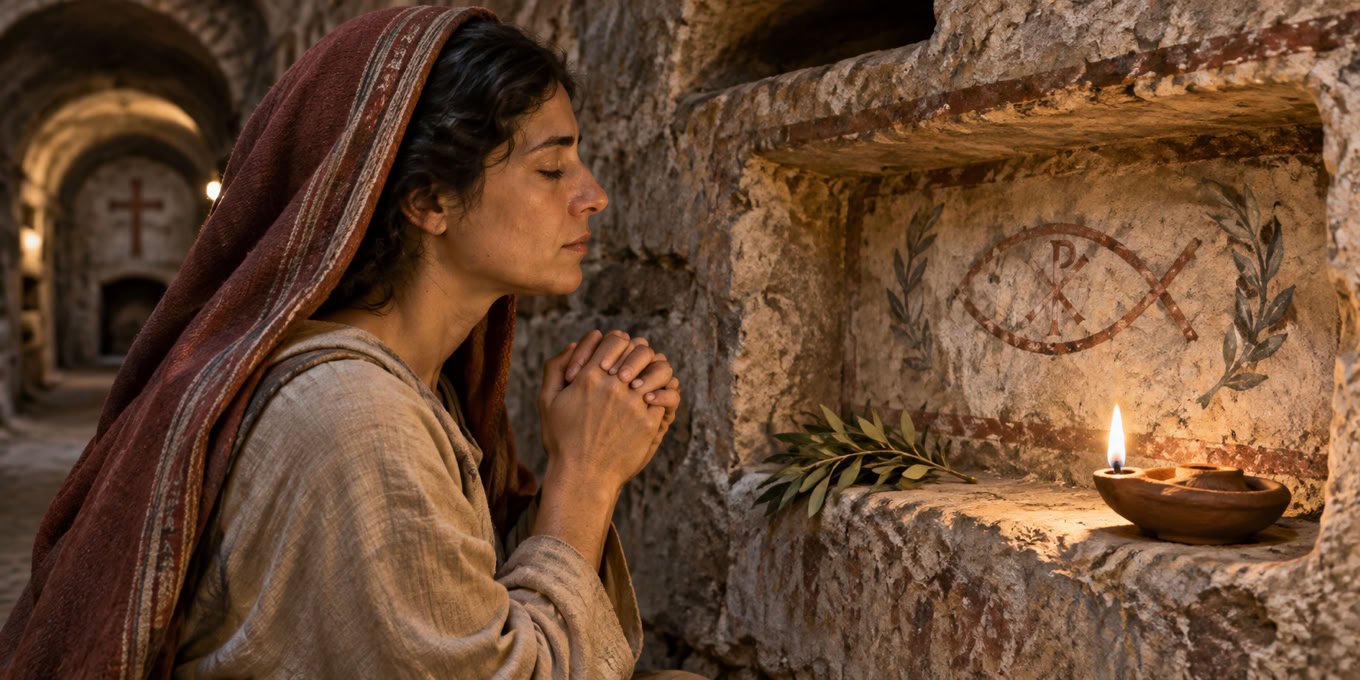
Writing in the early third century, the Christian author Tertullian described the practice of a widow praying for her deceased husband:
Indeed, she prays for his soul, and requests refreshment for him meanwhile, and fellowship (with him) in the first resurrection; and she offers (her sacrifice) on the anniversaries of his falling asleep.1
Tertullian mentions prayers for the dead in passing, without feeling any need to explain or defend the practice. This suggests that it was already familiar to his Christian readers.
Gregory of Nyssa: Purification after death
In the fourth century, Gregory of Nyssa described something even closer to the Catholic understanding of purgatory.
In his work On the Soul and the Resurrection, Gregory explained that people who die still attached to sinful desires may need to be cleansed of those attachments after death.
He distinguished between those who had been purified during their earthly lives and others who would be purified afterward:
Some having at once in this life been cleansed from evil, others having afterwards in the necessary periods been healed by the Fire.2
Notice that Gregory describes this purification as a healing. Its purpose is to free the soul from the sinful attachments that prevent it from fully enjoying union with God.
Augustine: Temporary punishment after death
In the early fifth century, Augustine also taught that some people undergo temporary punishment after death.
In The City of God, he wrote:
But temporary punishments are suffered by some in this life only, by others after death, by others both now and then; but all of them before that last and strictest judgment.3
Augustine went on to explain that not everyone who undergoes temporary punishment after death is destined for eternal punishment.
This is particularly significant because Augustine clearly distinguished between temporary suffering after death and the everlasting punishment of the damned.
Was purgatory a later invention?
The evidence is clear. Christians were praying for the dead by the early third century. In the fourth century, Gregory of Nyssa explicitly taught purification after death. And in the fifth century, Augustine described temporary punishment after death that was distinct from eternal condemnation.
The Catholic doctrine of purgatory didn’t appear out of nowhere centuries later. Its essential elements can be found in the writings of the early Christians.
__________
1 Tertullian, On Monogamy, 10.
2 Gregory of Nyssa, On the Soul and the Resurrection.
3 Augustine, The City of God, 21.13.
Featured Articles
Copyright © 2024–[YEAR] Catholic Odyssey